IN THERE ELEMENT
Three area artisans connect with the earthby Tor Lukasik-Foss / Photography by Chris Gallow
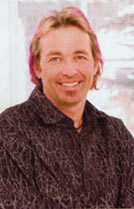 Walk into Walt Rickli's Lowville studio and your mouth will drop. There's a big, computerized diamond saw with a circular blade the size of a tractor wheel. There's an overhead crane for big lifting. There's a dust extractor which reaches every corner of the building. Outside there is a snow-covered field the size of three tennis courts, covered with huge rocks. This isn't a studio as much as a one-man factory. After all, Walt Rickli doesn't work in stone; he works in boulders.
Rickli talks about his profession with the zeal of an athlete explaining an extreme sport, and his stories are nothing if not heroic. When he hit 35, he turned his back on a lucrative job with his family's landscape-design company in order to pursue art full time. After a stint studying in Vermont with some of North America's best granite carvers, he came back to the area, charmed his way into an empty storehouse on a limestone quarry, and began putting together what just might be the most modern stone carving studio in the country. He self-marketed himself aggressively to interior decorators and architects; a decade later, he can boast a client base that stretches to every corner of the continent. "I wasn't going to be one of these artists who makes work and waits for somebody to discover their genius," he says. "I knew there would be clients out there who would want my work, and that I had to go out and find them. So I went to Indigo, got a bunch of magazines on sculpture, garden design, interior design, and started writing down names of every architect, designer, or venue that might be interested in what I do, and I started mailing postcards of my work to them."
Rickli is deeply proud of his reputation as a stone worker who loves a challenge. "What's key to what I do is having a team of people behind me. So if a client says they want a fireplace, only they want one that doesn't touch the ground, I have an engineer I can turn to who can help me solve that problem. I also know a machinist who will make the pipe fittings for a bathroom sink carved into a foot-thick block of stone.
Or the cabinet maker who will build the perfect base to support that sink. I remember when this woman wanted a 26,000-pound boulder in her home, and the only way to get it in there was take off her roof and drop it in by crane. The first thing I did was say yes to the job, and then I went to my team to figure out how the heck to do it.That's how I like to work."
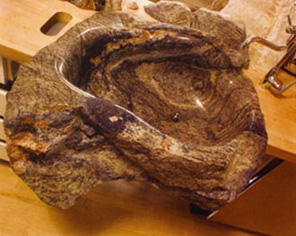 One chunk of Rickli's time is devoted to custom designing sinks and other home fixtures, another to creating large, interactive water sculpture and stone installation for a range of public and private institutions. The remainder is used for fine art pieces and garden works. If there is a theme running through what he does, it may be the cavalier approach to scale (he loves making big, adventurously engineered pieces), and an almost religious devotion to the whim of the stone. "Most carvers will use what they call monument-grade granite if they're doing a sink or a large sculpture, because the stone is consistent throughout and you are unlikely to encounter large cracks or veins or deposits of other kinds of stone. I like working with all kinds of stone. I carve in such a way that if I encounter a vein or a feature that's interesting, I can work with it, showcase it a little. It's like letting the stone tell you how it should be carved. There's always a risk that you'll lose the whole piece, but it's always a worthwhile risk."
Rickli also does not separate his work into functional and artistic categories. To him, the functionality is just a means to draw people deeper into an appreciation of the stone. "I just finished a sink where there is a long channel leading away from the basin to the drainpipe," he says. "This means if you are throwing a dinner party, you can put some candles in the sink and treat it like a fountain, an artistic centrepiece. Later you can wash your dishes or brush your teeth in it, and when you're done, watch the water drain away along this tiny stream. I like that. Art should be like that – I mean, why shouldn't brushing your teeth be an adventure?"
Hamilton Magazine's Interiors
September, 2004