
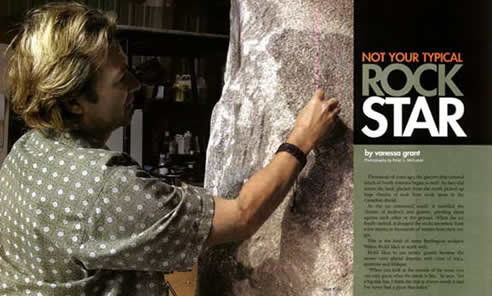
NOT YOUR TYPICAL ROCK STAR
By Vanessa GrantPhotography by Peter C. McCusker
Thousands of years ago, the glaciers that covered much of North America began to melt. As they slid across the land, glaciers from the north picked up large chunks of rock from weak spots in the Canadian shield.
As the ice continued south, it tumbled the chunks of bedrock and granite, grinding them against each other or the ground. When the ice finally melted, it dropped the rocks anywhere from a few metres to thousands of metres from their origin. This is the kind of stone Burlington sculptor Walter Rickli likes to work with.
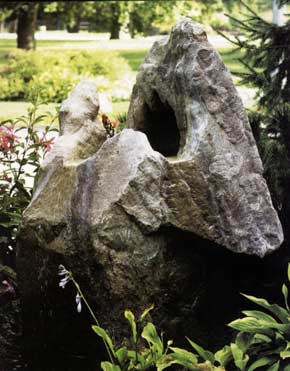 Rickli likes to use erratic granite because the stones carry glacial deposits with veins of mica, quartzite and feldspar. "When you look at the outside of the stone you can only guess what the inside is like," he says. "It’s a big risk but, I think the risk is always worth it and I’ve never had a piece that failed."
Rickli lets the stone and its composition guide the sculpture. While working on a form of a turtle, he found a big chunk of unstable mica right where the head was supposed to be.
"So I was like, ‘what am I supposed to do now?’ Then I thought, ‘OK, I’ve got enough room, I can move the head over.’ In its own way, the stone had a say in where the head was going."
Rickli’s artistic journey began with gardens. He graduated from the University of Guelph in 1976 with a degree in horticulture and spent 20 years building gardens for his family business.But about seven years ago, the ice began to melt. A friend gave him a book about Japanese water basins – bowls carved into stone, historically used in ancient Japanese shrines and temples.
Rickli began to create these basins for gardens. On Sunday mornings he would begin carving until he suddenly felt hungry and realized it was 5 p.m. The whole day had disappeared. "I liked that feeling, and I thought, that’s what I want every day to feel like for the rest of my life," he said.
Today, he still gets immersed in the job. "There’s something wonderful about carving. You need to think about so many things," he said. "Where the chisel is going, where the mallot is going, what sound does it make? What am I creating? Your whole body has to move. You’re involving so many things, physically and mentally, that you just get lost."
Because of his success with water basins, Rickli decided to study with The Stone Mason Guild. After a year of researching sculptors, he approached three of North America’s finest granite sculptors. He eventually spent three years studying with Garry Sassi, Jim Sardonis and Guilliano Cecchinelli. He fulfilled his obligations to the family business, and then started his own.
Though he often sculpts alone, he loves working with clients. When creating, he starts by making a small model. If the sculpture is a commissioned piece, the client might visit the gallery and garden in Lowville for inspiration. Some people see a sculpture in the garden, love it and buy it. But most people use what they see in the gallery for inspiration. Then he and the client discuss style, size, shape and type of stone, budget and whether or not there will be a water feature.
His pieces range in price from $100 for a small water basin to his largest work to date, which cost $100,000. Most of his work is in the $10,000-$20,000 range.
Once both budget and style have been pinpointed, Rickli picks out a few stones for clients to choose from, laying them where the main features will go.
"It’s very exciting. People like stone. They’re touching it, they’re walking around it. Sometimes, a husband and wife might disagree, then all of a sudden they’ll look and go, ‘oh, that’s the one!’ That’s when the fun begins." Says Rickli, smiling.
Many clients return to the gallery to watch the piece taking shape. His workshop is crammed. Between chisels, diamond blade saws, diamond abrasives (which are like sandpaper for stone), dust extractors and cranes, Walter estimates that he has around $400,000 in equipment. Many of the tools and basic principles used by Michelangelo don’t differ much from the way Rickli sculpts, though technology does make it easier today.
Rickli has a three-foot diamond saw and uses a carving gun that hooks up to an air compressor. The chisel sits in a hole in the end and the gun hits the end of the chisel like an air-powered hammer. With the diamond saws, Walter makes what he calls stress cuts. Once the cuts are made, he can hit that chunk with a hammer and chisel and remove a lot of stone. When he’s within an inch of where he want the detail to start, Rickli uses a chisel. If the detail is very intricate, he uses an old-fashioned hammer. There is always work in progress in the shop – sculptures can take half a day for a small water basin or up to six months for a large piece. "Sometimes you get bored of doing one thing," he said. "If I’m carving really detailed eyes or something, it’s very intricate work and after two or three days of that, of little specks of dust coming off, you want to remove a lot of stone, so I do something else."
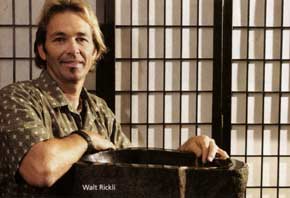 He believes that everything around us possesses an energy. When someone puts a lot of love and their own energy into something, he believes that people can feel that. He uses gardening as an example. "You can walk into a little teeny garden and go ‘oh, I feel great.’ You can walk into another garden that’s well-designed, and you don’t feel anything. Why is that?"
Rickli says it has to do with who and why the garden was created. A homeowner who loves gardening, even if they don’t know much about design, will create a space with lots of positive energy.
Stone sculpting is miles away from where he started, but it’s just where he wants to be.
"I absolutely love what I do. I can’t wait to get up in the morning," he said.